
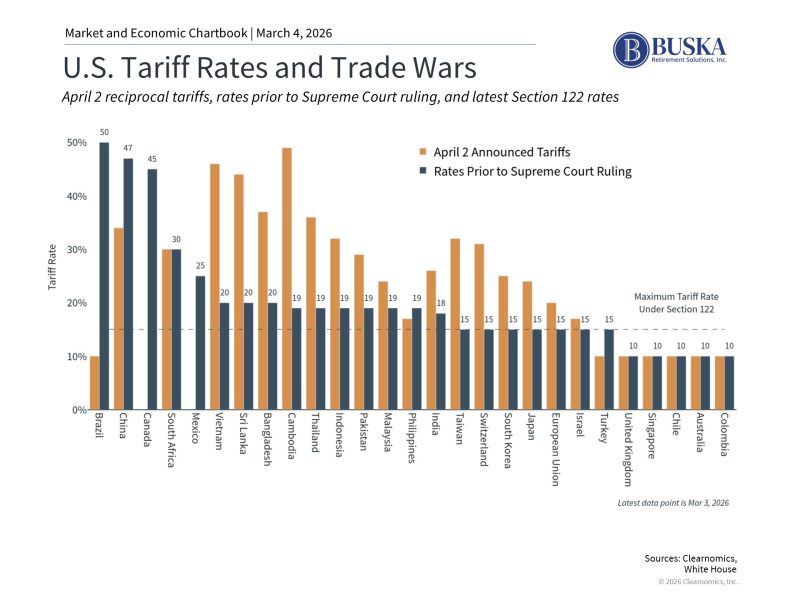
The chart referenced here highlights how import tariff levels have shifted across countries, contributing to short-term swings in investor sentiment.
On February 20, 2026, the U.S. Supreme Court issued a 6–3 decision limiting the administration’s use of the International Emergency Economic Powers Act (IEEPA) to impose broad tariffs. The ruling determined that the sweeping tariffs enacted under IEEPA were unlawful — a decision that carries meaningful implications for investors and businesses alike.
What Was Struck Down?
The Court’s decision invalidated tariffs that had been applied to nearly every country based on trade deficits, along with tariffs on Mexico, Canada, and China related to fentanyl concerns. It also eliminated the widely discussed “reciprocal tariffs” announced during last April’s “liberation day.”
However, not all tariffs were removed. More targeted duties on steel, aluminum, and automobiles remain in place under separate authorities.
What About Refunds?
One of the biggest outstanding questions is whether businesses will receive refunds — and how that process would work. Thousands of companies were involved in the lawsuits that ultimately reached the Supreme Court, and the financial implications are significant.
According to data from U.S. Customs and Border Protection, roughly $90 billion of the approximately $195 billion collected under IEEPA could potentially be subject to refund. If enacted, that would affect a wide range of industries, from manufacturing to retail to agriculture.
At this stage, the mechanics and timeline of any refund process remain unclear.
What Could Happen Next?
While this ruling limits the administration’s ability to use IEEPA for broad-based tariffs, it does not eliminate tariffs altogether. The White House may attempt to reimplement tariffs under other legal authorities. Those frameworks typically come with more procedural requirements and a narrower scope, which could reduce the likelihood of sweeping, economy-wide measures.
In short, this decision removes one powerful policy tool — but trade policy uncertainty has not disappeared entirely.
Market Impact: Volatility vs. Fundamentals
Trade policy has been a key source of market volatility over the past year.
Yet despite the policy back-and-forth, markets have shown resilience. That’s an important reminder: while political and trade developments can drive headlines and temporary volatility, long-term market performance is typically driven by fundamentals — corporate earnings, economic growth, and valuations.
The Bigger Picture for Investors
Policy shifts like this can create uncertainty in the short term. However, reacting emotionally to headlines has historically proven far less effective than maintaining a disciplined, long-term investment strategy.
Trade negotiations, court decisions, and regulatory adjustments will continue to evolve. But for investors focused on long-term goals, the core drivers of portfolio growth remain unchanged.
If you have questions about how policy changes may affect your portfolio or your financial plan, we’re here to help you evaluate your options and stay focused on what matters most.